





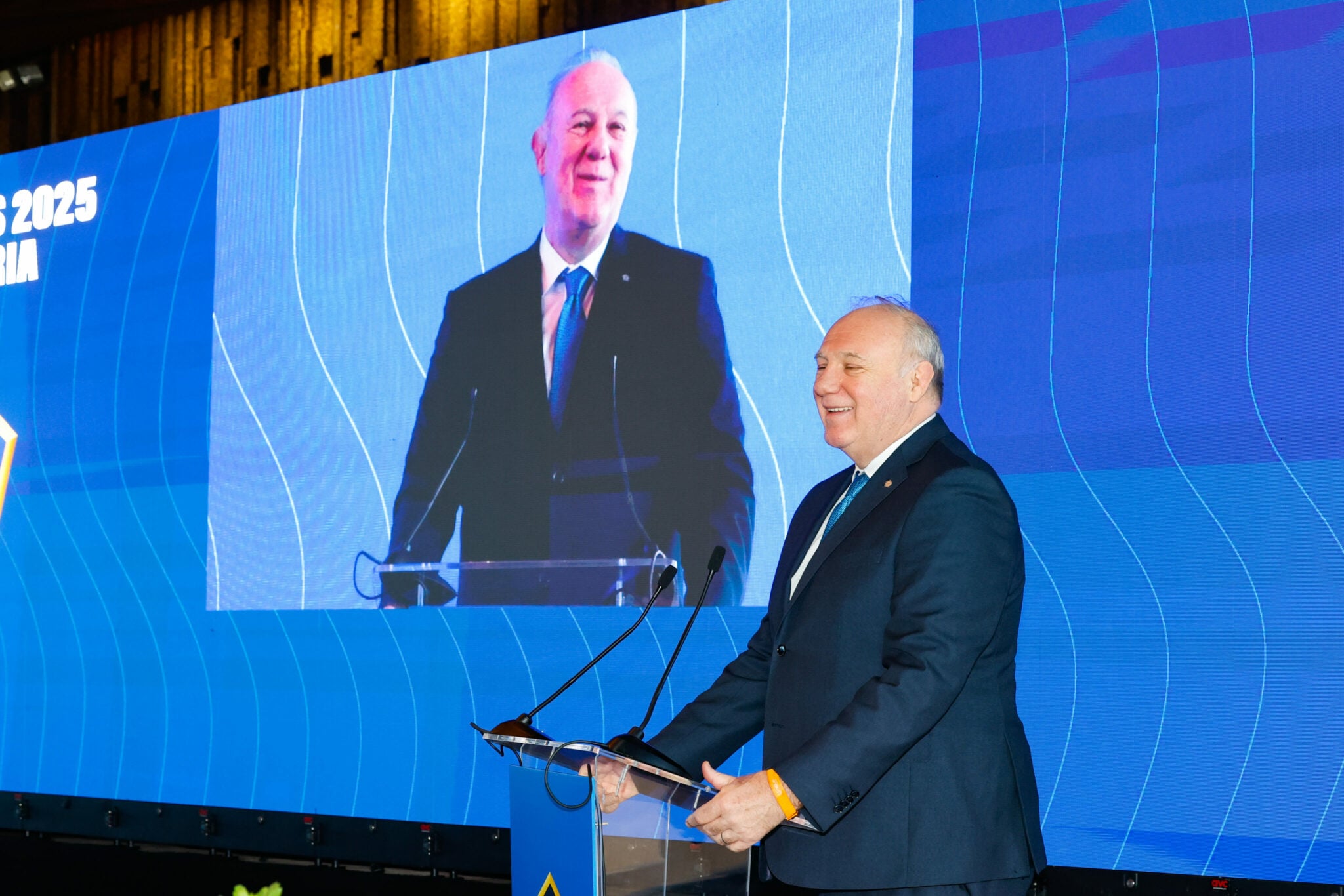
During the 77th Ordinary Congress of the European Judo Union, there were many moments of reflection but few carried as much weight as the address delivered by EJU President, Dr Tóth László. Taking time to look back on recent years, he offered a clear and confident assessment of an organisation that has not only grown but matured.

“The past three years have been truly eye-opening,” he began. “We have grown significantly across many areas, sectors, expertise and responsibility.”
He first congratulated the newly elected and re-elected presidents of EJU member federations, before highlighting Europe’s increasing influence on the global stage. This was underlined by the election of eight European representatives to the IJF Executive Committee, clear evidence of Europe’s leadership within international judo.
The President took particular pride in the scale and consistency of the EJU calendar. With 107 events in 2023, 101 in 2024 and a record 114 events in 2025, the numbers told a story of both ambition and organisational strength. That capability was further demonstrated in 2025, when Europe hosted four of the five IJF World Championships: the Senior World Championships in Hungary, the Cadet World Championships in Bulgaria and the Veterans and Kata World Championships in France.
“Not only is our growth evident,” Dr Tóth noted, “but our organisational skills are exceptional and they are recognised worldwide.” This recognition was also reflected in the EJU’s media development. Growth in JudoTV and broadcast sales resulted in a 33% increase in revenue from 2024 to 2025, strengthening both visibility and sustainability.
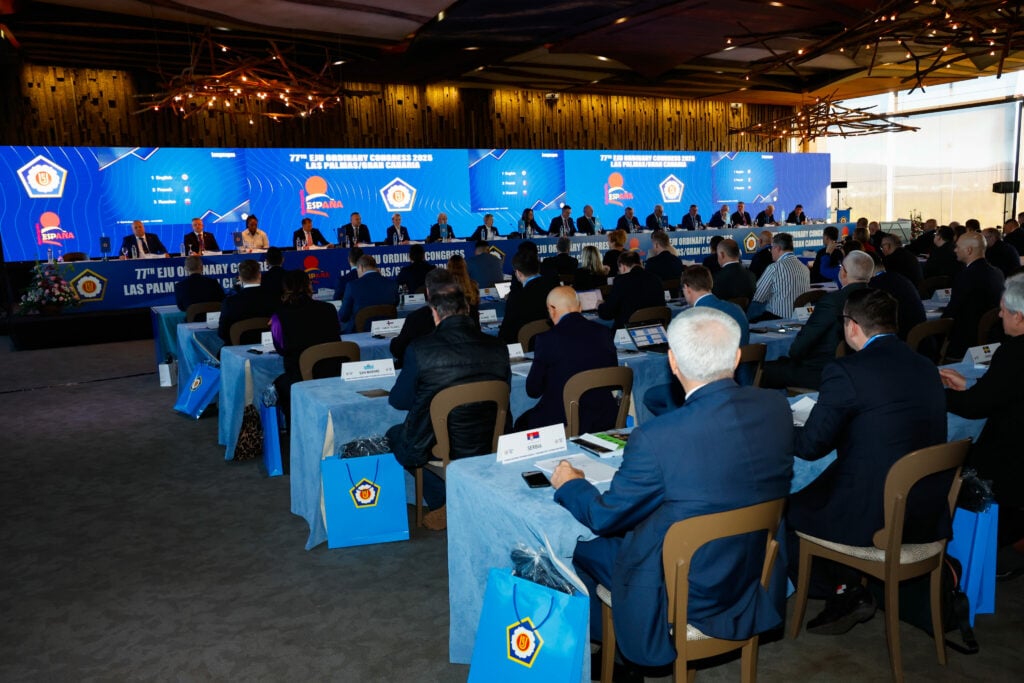
Beyond numbers, the President highlighted a year rich in innovation, with Europe leading several key initiatives, including the IJF Academy, Kodokan activities, Kids Camps, the Ne-Waza European Championships, the European Hopes Tournament, Kata Festival for All, and the continued development of Adapted Judo as a future self-sustaining programme.
When speaking of 2026, Dr Tóth outlined two important ambitions: opening EJU’s Club Championships to global participation and launching a collaborative project with France Judo focused on the development of Colour Belt Championships.
One of the most personal moments of the address came as Dr Tóth spoke about Adapted Judo, a programme that has become a defining pillar of the EJU’s social responsibility.
“This programme creates opportunities not only to compete but simply to enjoy judo,” he said, “for children, adults and entire families living with disabilities, everyday life can be challenging in society. If we can be a place where they can breathe, feel welcome and enjoy themselves, then it is our responsibility to provide that.” Its impact will reach an even wider audience in 2026, when the IJF Grand Slam in Lausanne, Switzerland, announced as a fully inclusive event, will incorporate the EJU’s Adapted Judo programme.
The President also reflected proudly on the EJU’s prime events of 2025, three of which were historic firsts: Montenegro hosting the Senior European Championships, North Macedonia the Cadet Europeans, and Moldova the U23 European Championships.
“We are in an era where countries are competing for the right to host,” he observed, “and that shows the collective desire to grow our sport, regardless of size or resources.”
A landmark moment of the Congress was the adoption of the EJU Human Rights Declaration, reaffirming commitments to gender equality, diversity, accessibility and safeguarding. “By adopting this declaration, we unite as a judo community to ensure our sport remains a safe, fair and inclusive environment for all,” Dr Tóth stated.
He closed by acknowledging the power of judo to transcend political and cultural divides, welcoming the IJF decision allowing athletes from Russia and Belarus to compete under their own flag.
“Judo has always shown that sport should have no barriers,” he concluded.
As the Congress drew to a close, the message was unmistakable: the European Judo Union is not standing still. It is moving forward, with confidence, responsibility and a deep belief in the values that define judo.
Author: Szandra Szogedi