





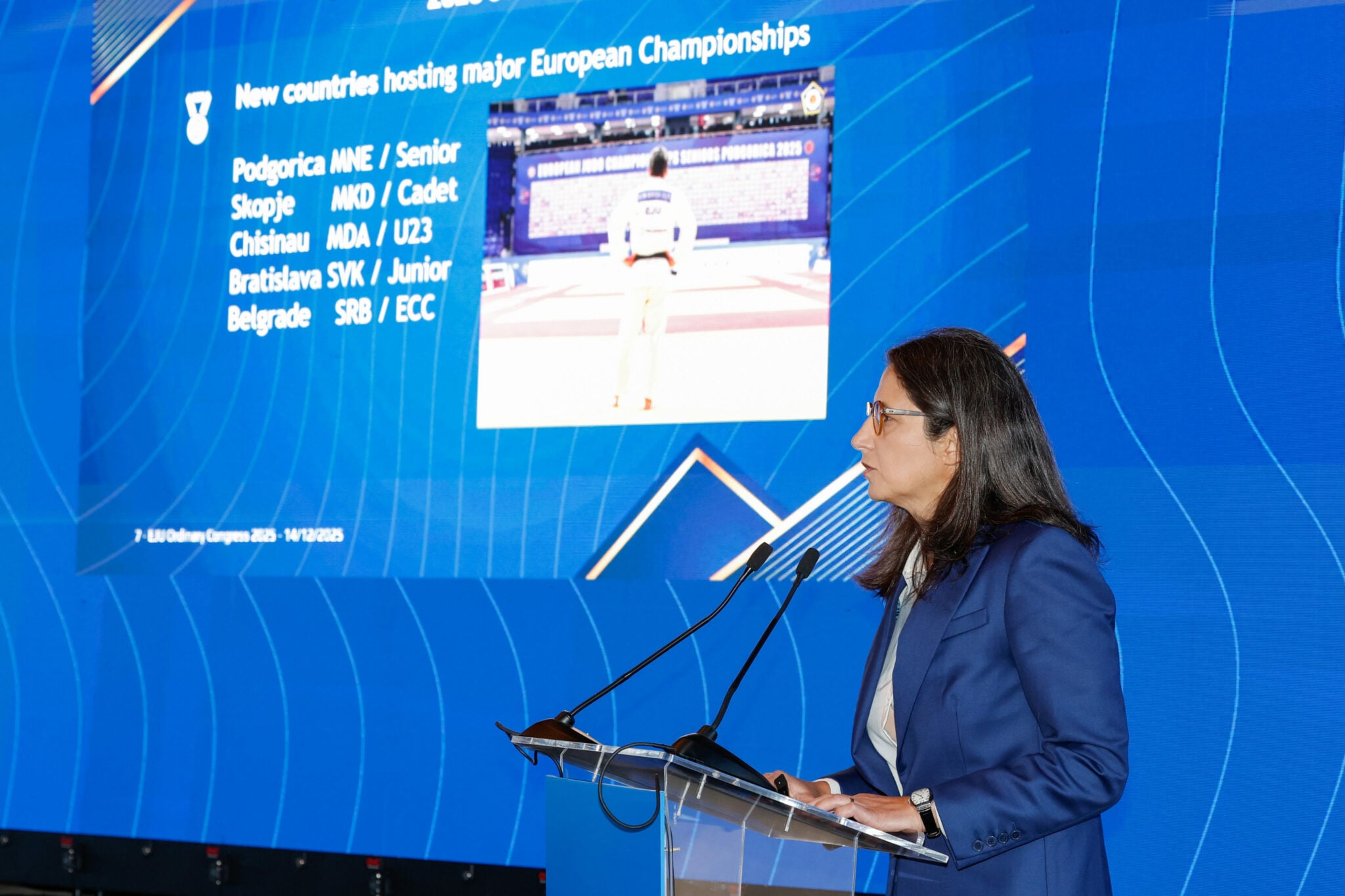
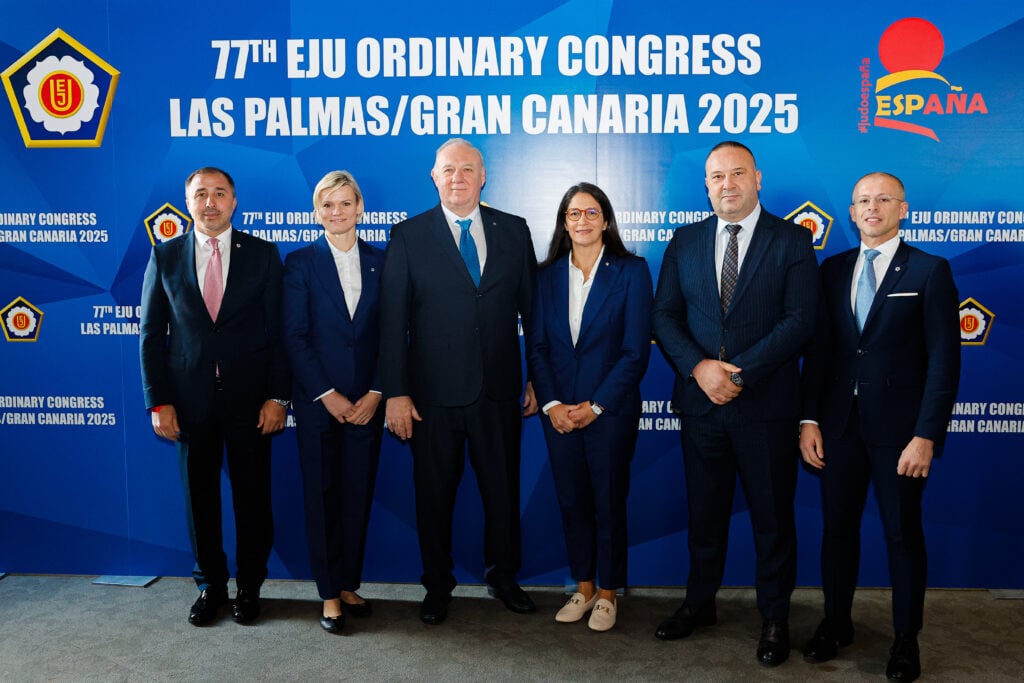
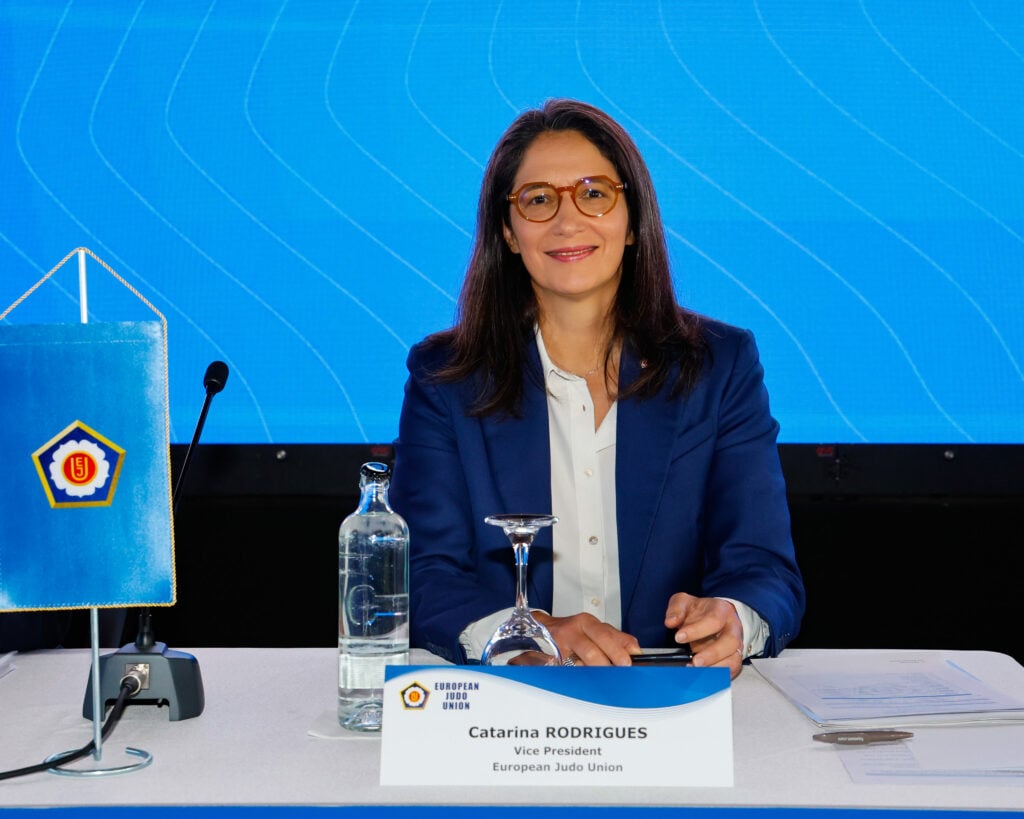
At the 77th Congress of the European Judo Union in Las Palmas, EJU Vice President of Sport, Catarina Rodrigues, also took time to reflect on a year that, in her words, proved just how far European judo can go when trust and opportunity are placed in the right hands. Speaking openly and personally, she reviewed the sporting highlights of 2025 and shared a clear vision for the road ahead.

“If I had to choose just one highlight from 2025,” Rodrigues begins, “it would be the remarkable potential shown by our smaller member federations.”
For her, the year was defined not only by medals or numbers but by confidence earned. Serbia and Slovakia confirmed their growing strength as organisers of continental championships, while Montenegro, North Macedonia and Moldova took an even bolder step, successfully delivering their first-ever European Championship events.
“They proved that when you give them the opportunity, they rise to the occasion,” she says. “These events inspired local athletes, increased community interest and showed very clearly that judo is developing everywhere across Europe.”
Alongside this, the European Judo Tour, particularly the Cadet Cups, continued to thrive, with strong participation underlining the health of the sport at grassroots and developmental levels. In 2025, the Sport Sector introduced several important operational changes aimed at improving communication, education and event quality.
One notable return was the live draw format at European Championships. “This was about reconnecting with our coaches,” Rodrigues explains. During the Cadet European Championships, the draw was accompanied by a dedicated workshop for coaches, focusing on the newly created EJU Code of Conduct and the medical implications of athletes losing consciousness through shime-waza techniques.
“This came directly from what we observed in 2024,” she notes. “It led to close cooperation with our Medical Commission and a shared responsibility to raise awareness and protect our athletes.”
The National Federation Support Programme was also redefined. Instead of a one-sided model, responsibility is now shared between the EJU and each federation, a change Rodrigues describes as “much more effective and sustainable”.
Developing young talent remains one of the Sport Sector’s greatest responsibility. In 2025 alone, the EJU organised close to 100 sporting events, generating around 28,000 participant entries across all age groups. “Our focus must start early,” Rodrigues says. “Pre-cadet education and technical training are important and two years ago, the hopes tournament project for pre-cadets was launched and has since shown strong development. It remains focused on the education of young judoka by providing high-quality technical sessions alongside a pressure-free competition model.”
Through the European Hopes Project, technical guidance from European heroes and Kodokan experts is combined with a pressure-free competitive environment. At the other end of the spectrum, Olympic Training Centres continue to serve elite athletes preparing for World Championships and the Olympic Games. “Our Olympic Training Centers are our key project for the elite athletes. They are schedule on key preparation periods, also with assistance provided by our EJU Coach commission.“
Between these stages, Cadet and Junior Tours, each paired with three-day training camps, alongside the Senior Tour and the U23 European Championships, form the backbone of athlete progression. “Our goal,” she explains, “is a smooth pathway from pre-cadet to elite level, where every athlete finds the right environment for their stage of development, not just technically, but mentally and emotionally as well.”
Hosting three major European Championships in the same year with first-time continental organisers initially seemed daunting. Yet, Rodrigues describes it as one of the most rewarding experiences of 2025. “With Montenegro, North Macedonia and Moldova, we built detailed plans including test events, technical visits and constant dialogue,” she says. “What made the difference was their dedication, passion and humility.”
Harmonising nearly 25 different organisers across Europe is never simple. The Sport Sector relies on clear event job descriptions, unified procedures and continuous evaluation as well as their 21 Sport Commissioners, each with diverse judo backgrounds, attend events not to police but to support.
“They are there to be part of the solution,” Rodrigues emphasises. “That team spirit is essential.”
Now, 2026 will be a year of consolidation rather than expansion. One major structural change will see the Senior European Championships split: individual competitions in April in Tbilisi, Georgia, and the Mixed Team Championships in November in Belgrade, Serbia. Federation support will continue under a refined system introduced in 2025, with clear requirements linked to participation in European Championships. That year alone, the EJU supported 81 athletes from 27 federations.
Rodrigues is also keen to highlight the work of the Coaches Commission, led by Urska Žolnir Jugovar. The Vice President shares further: “For 2026, would like to invite more top-level coaches to join our online activities and to continue participating in IJF Referees training sessions before IJF events, something that’s only possible because of the constant support we get from the IJF. If possible, we aim to build a closer relationship between our EJU Athletes Commission and the with the IJF Athletes Commission. They feedback is always important to us.”
Moreover, the EJU Code of Conduct will be actively enforced across all events, and successful initiatives, such as the coaches’ workshop at the Cadet Europeans in Gran Canaria, are set to be repeated. “We are committed to continuing close collaboration with all other EJU Sectors. Our projects frequently overlap different areas, particularly Refereeing (including OTC and TOP referees at Cups) and Education. The Code of Conduct and event organisation support projects intersect with the Education sector, and we will continue providing technical support for the organization of their Adapted Judo and Veterans events.“
To support the people behind the scenes, a new mentoring programme for Sport Commissioners will be launched, alongside the annual online Sport Seminar on 10 January. As the conversation closes, Rodrigues returns to a recurring theme: collaboration. “To manage all of this,” she says, “you need a dedicated, professional team in constant contact with our federations.”
It is clear that for her, 2025 was not just about what was achieved but about how it was achieved. Through trust, shared responsibility and belief in people, European judo continues to grow, one opportunity at a time.
Author: Szandra Szogedi