





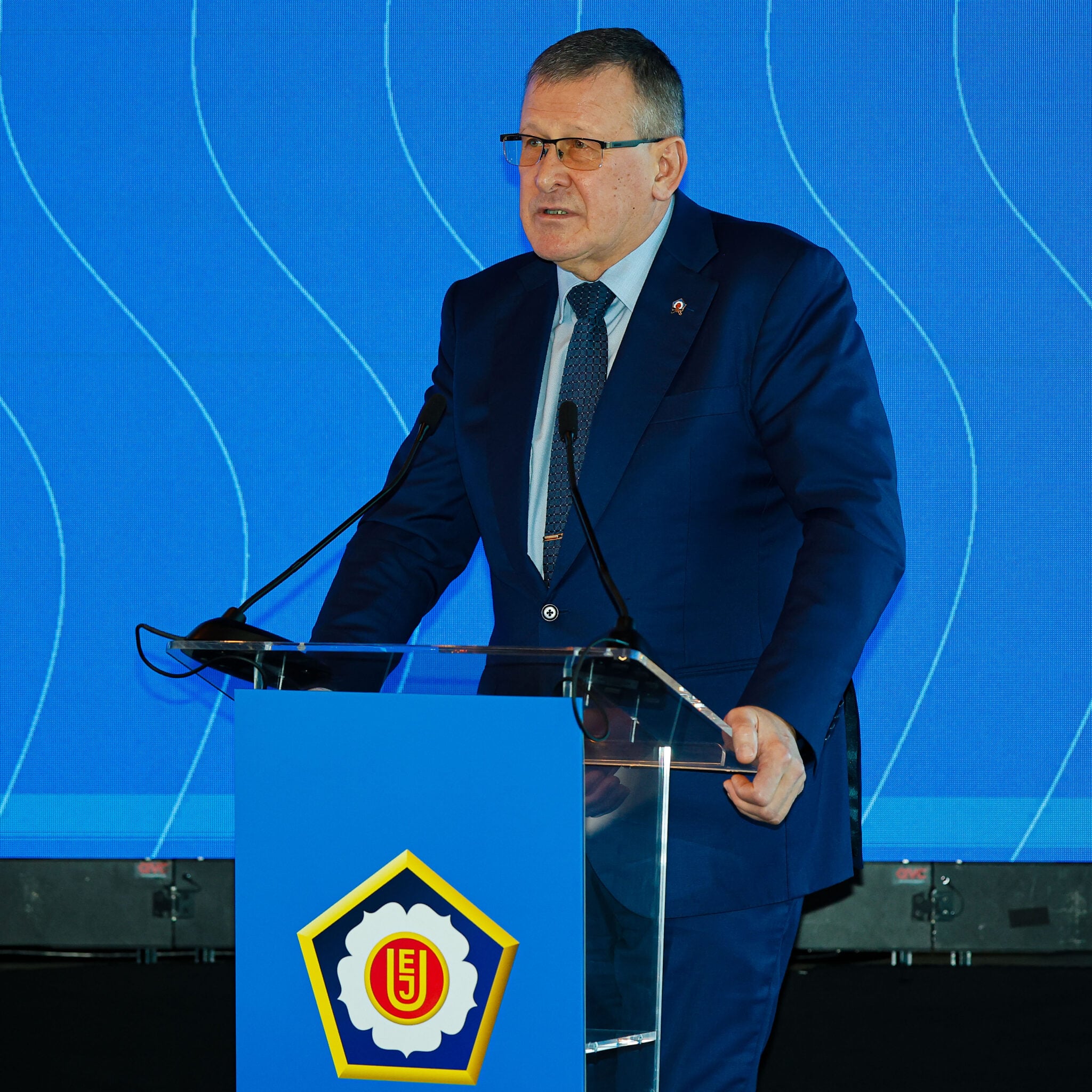
Aleksandr Jatskevitch, the European Judo Union’s Head Referee Director, reflects on 2025 as a year that demanded flexibility, unity, and an unwavering commitment to quality across all levels of refereeing. As he looks back on the EJU Ordinary Congress, the sense of progress is clear. Twelve new IJF International licence referees and 28 Continental licence referees successfully passed their examinations, while Europe’s top refereeing officials continued to deliver strong performances throughout the IJF World Tour and at World Championships in every age category. European Championships also benefited from a consistently high standard, something Jatskevitch attributes to both the work within the EJU and close alignment with global refereeing structures.

This alignment became particularly important as the season unfolded. In the months following the Paris Olympic Games, referees were asked to adapt to a series of rule updates and clarifications, some of which were introduced almost event by event on the IJF World Tour. For Jatskevitch and his team, the priority was ensuring that European referees remained fully in step with the IJF. The presence of IJF Head Referee Directors at European Championships was invaluable, enabling real-time discussions and harmonised interpretations. Collaboration, he says, was the essential lesson of the season: only by working closely with IJF counterparts can Europe maintain consistency and the highest standards of quality.
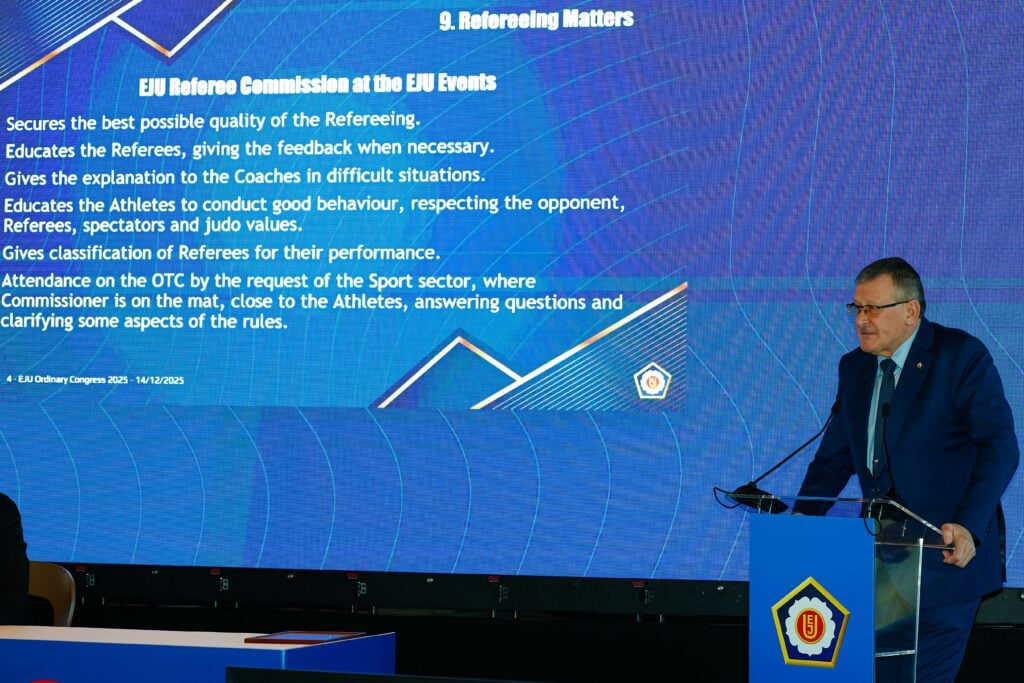
Despite the challenges, the year brought noticeable improvements on the tatami. Jatskevitch points to better management of transitions, particularly in recognising incorrect calls of Matte in ne-waza, along the edge of the mat, or during fluid shifts between standing techniques and ground engagements. Referees also showed more confidence and accuracy in these dynamic phases. Yet some areas still require deeper attention. Applying Shido for passivity, identifying negative judo, finding the best position to observe submissions, and evaluating impact for scoring remain core priorities for continued development.
Among the rule interpretations that caused debate during the season, two stood out. The first was Yuko. Despite clear explanations at the IJF Technical Meeting in Istanbul at the end of 2024, many referees struggled with the practical application, particularly the question of how far forward the impact could be for it to count. Only after the World Championships in Budapest, where a simpler definition was confirmed, essentially a side impact without stomach or knees, did the issue fade. With clearer guidance, referees were able to encourage more positive judo and rely less on Shido.
The second recurring challenge involved Shido itself. Thanks to new rules on edge-of-the-mat situations and unconventional grips, many technical Shido decreased, which Jatskevitch considers a positive development. But the boundary between passivity, activity, and negative judo still caused inconsistency. “Referees still need to feel fighting judo,” he says, emphasising the need for instinct as well as theory.
More rule updates are expected for 2026, and the EJU Refereeing Commission is already preparing. As soon as changes are confirmed, they will be introduced on the EJU circuit through briefings, personal feedback, and targeted support. The IJF Referee and Coaches Seminar scheduled for late May in Sarajevo will be an important milestone in this process.
Transparency remains another focus. The EJU hopes to extend the use of video replay during events, particularly to help explain difficult situations to athletes, coaches, and sometimes even spectators in the hall. Commissioners increasingly invite coaches to review unclear moments together, ensuring that decisions become learning opportunities rather than sources of frustration. Referee Commissioners will also attend EJU Olympic Training Camps to answer questions and analyse video cases directly with athletes and coaches.
The development of young referees continues to be a source of motivation. Many national-licence referees are now entering the European circuit, and twenty-three passed IJF examinations this year alone. Jatskevitch notes the promising talent visible at European Cup events and stresses that education goes far beyond knowing the rules. For him, professionalism includes behaviour, social interaction, grooming, posture, movement on the mat, and clear gestures—every detail that contributes to authority and respect.
A major technological step forward this year was the widespread introduction of the new Ferar Replay Care System, allowing slow-motion review down to fractions of a second and from multiple angles simultaneously. It has already helped prevent mistakes and sharpen decision-making. The goal is for every EJU event to have access to this system in the future.
When it comes to evaluating performance, Jatskevitch defers judgment to others. His focus is on identifying flaws, studying constructive criticism, and ensuring referees receive the support they need. Selection processes will continue to rely on the EJU Referee Ranking List unless directed otherwise by the EJU President. On the global stage, Europe traditionally fills the maximum possible quota at the Olympic Games. Eight of the sixteen referees in Paris came from Europe, a balance that cannot increase because the remaining positions must be distributed across the other continents. Maintaining high performance is therefore essential if European referees are to keep earning those places.
Athlete safety remains an integral part of refereeing, and Jatskevitch stresses how often injuries can be prevented simply through well-timed Matte calls. But he also urges coaches to take responsibility for training methods that can lead to dangerous competition habits. Examples such as diving during Uchi-mata or reckless approaches to waki-gatame, kani-basami or kawazu-gake, he says, begin in the dojo. Referees have just follow the rules; coaches must ensure athletes do not develop risky techniques in the first place. His ideal vision of fair play even includes coaches acknowledging when a score belongs to the opponent or when their athlete deserves a penalty, an optional thought, but one that reflects his deep belief in judo values.
Looking ahead to 2026, the challenges are familiar but demanding: achieving flawless referee performances at European Championships, earning selections and excelling on the IJF World Tour, and maintaining Europe’s position among the world’s strongest refereeing bodies. Jatskevitch’s personal aim is simple but ambitious: to ensure perfect refereeing at all EJU events and to provide referees with the support they need from Commissioners and the EJU’s top officials. Feedback, he believes, is the key ingredient that will help European referees stay among the world’s best as the next Olympic cycle approaches.
Asked about moments that stand out from 2025, he speaks not of individual decisions but of teamwork. He is proud of a group that repeatedly came together to find the right solution in difficult moments. The shared satisfaction of seeing the correct winner leave the tatami, he says, is one of the purest rewards.
After a lifetime in judo; as an athlete, coach, referee, and referee director for decades, he continues to live between Latvia and Belgium, a rhythm that feels natural after so many years on the road. “This is part of my life,” he says. “If I stopped doing this, then this part of my life dies.”
As the 2026 season approaches, his message to all EJU referees is shaped by experience and grounded in the values of judo: stay true to yourself, continue developing your judo and refereeing skills, maintain dignity, be honest, and respect others. And beyond the tatami, “Whatever happens, stay yourself, work on your Judo and Refereeing skills, keep dignity, be honest, respect other people. I wish people good health, prosperity, a successful job or business and happiness in the Family.”
Author: Hans Van Essen