





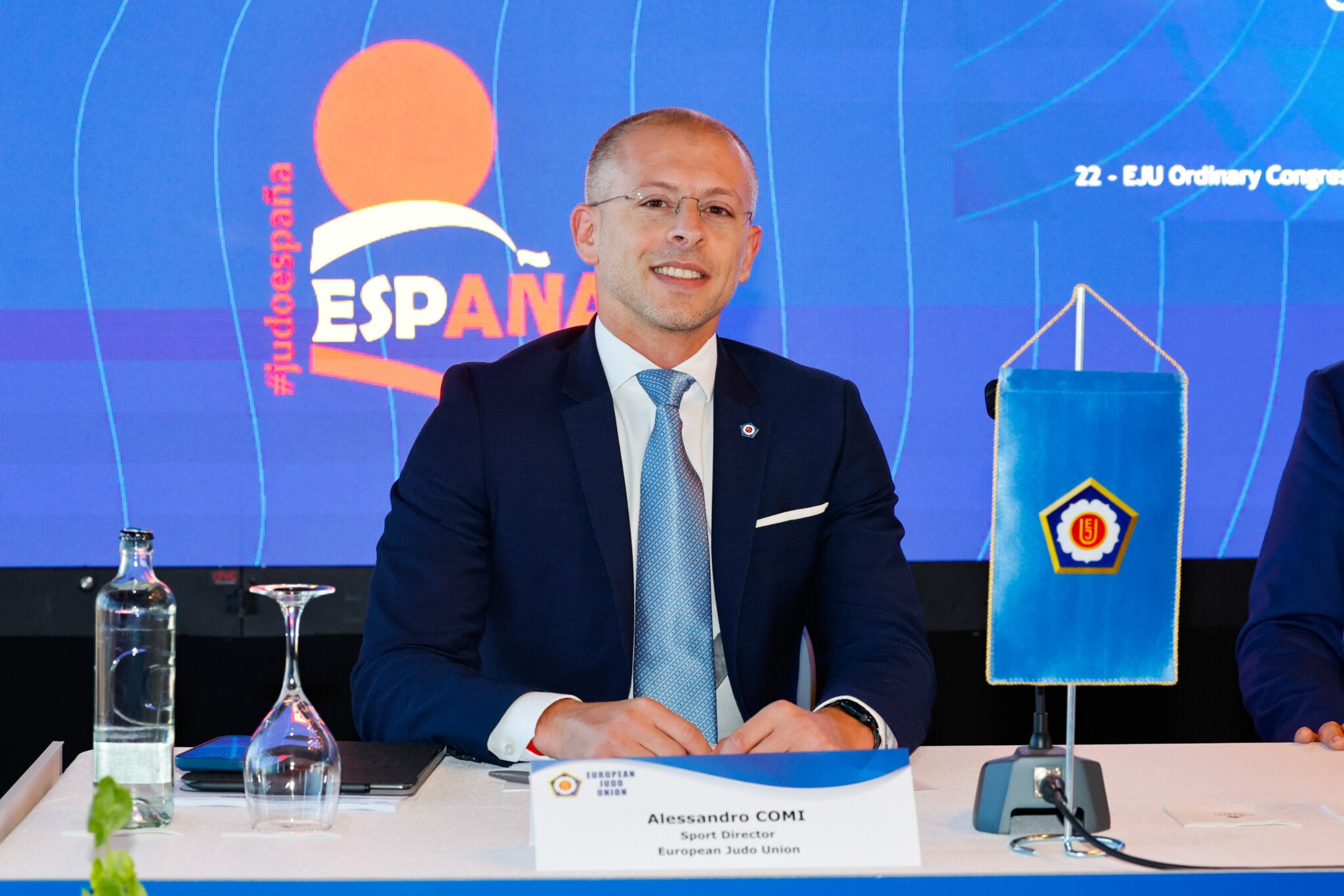
During the 77th Ordinary Congress, held in Las Palmas Gran Canaria, Alessandro Comi was elected as a new member of the EJU Executive Committee, assuming the role of Sport Director. Following his election, he took a moment to reflect on his journey, ambitions and vision for the future as he shared his thoughts with us.

Let’s begin…, could you tell us about your personal journey in judo? What first drew you to the sport and how has it shaped your career so far?
Alessandro Comi: “Long ago…I grew in a small village where every kid played football. I wanted to be the exception to the rule. I was 6 year old and I accidentally found an old book about judo on my grandfather’s bookshelf and with that, I found an opportunity. To be honest it was a horrible book about judo but judo was the perfect opportunity not to conform to what others did. My mother wasn’t entirely convinced but in the end my parents agreed and the deal was done.
“I had good skills but my mind was not strong enough to drive a winning career as a top athlete; then, at the age of 20 my training partner (a brother, a friend) tragically passed away and I was forced to grow up quickly. After my coach left the dojo I took over his position and I started a new journey.”
What key experiences or roles best prepared you for joining the EJU Executive Committee as Sport Director?
AC: “I am a product of the pandemic! In 2020 I used to work for the Italian Judo Federation as a coach and manager of the cadet team when the pandemic broke out. Italy was in the middle of the chaos and being one of the very first “survivors” to SARS-Cov-2 gave me the possibility to make a new experience. I was asked to put together different skills, to study and develop new ones and to drive our National Teams in the sea of the pandemic as Covid Manager. Then I joined the Olympic Team as Team Manager. That was the moment I got in touch with the EJU Sport Commission more and in 2021, I was asked to join the team.
“Being a coach and dealing with the management of teams of younger and top athletes helped me to have a wide knowledge of our judo world; together with this, leading a club, directing of educational and recreational centers for children and adolescents trained me to put myself in other people shoes: it is important when you have to take decisions.”
Who were the mentors or figures who influenced your path in judo?
AC: “In general, it is a difficult question for me…, I am an orphan of my mentors and I try to draw the best from all the judoka that somehow leave a mark on my experience, no matter if they are guru, champions or young athletes. Someone gives you insights into how to grow better, others show you their worst side. At the end, it is up to you to decide what you want or don’t want to take. In EJU, I hope I have the imprint of Vice President, Catarina Rodrigues, I owe her a lot of what I am today.”
What do you hope to bring to the EJU in your new role?
AC: “I wish I can bring more ‘connection’. I am not capable of seeing things in watertight compartments and I am sure that the greater the connection and dialogue between different sectors, the better the results can be.“
Which aspects of the sport do you believe need the most attention right now, grassroots, elite competition, coaching, refereeing or something else?
AC: “In sport, focusing on high-level athletes, champions and medals (which, let’s be clear, is an area I love) is a risk. The truth is that the world of judo is also, and probably above all, the part of the iceberg that remains underwater. The EJU is working hard on that: our motto “Judo more than sport” is also a clear vision I totally agree with. We need to listen to the world, to carefully observe where it is going and to offer judo as a natural tool to address life’s current challenges. It means to work on parallel pathways: one side to create better and better for events organisation and high-level athletes, coaches and referees, on the other to prioritise education through judo.”
Are there specific innovations you would like to see implemented in event organisation, athlete welfare or spectator engagement?
AC: “The modern sports industry has made the fan experience and spectator engagement a top priority. I don’t have any ‘killer idea’ ready on that but I trust we can work to create events that goes beyond the live game itself.”
You have been a pioneer in the development of the adapted judo programme. What further steps do you believe are essential for promoting inclusivity and expanding judo participation across Europe?
AC: “As for being the pioneer of Adapted Judo, I have to give way more credit to others as I was loaned to this project because they need someone who could develop requirements and protocols and to give the EJU trademark to events. It is also true that out of judo, as a neuropsychologist, I have a strong background in the world of health and disabilities. Nothing came by chance.
“Beyond my personal experience, I think that after two years Adapted Judo is no longer only ‘a project’. The Get Together Tour is now well established in Europe: under the umbrella of the EJU, we need to spread a common language that can lead the more appropriate steps to boost adapted judo in every nation. In this perspective, it is clear that education of all the actors involved (coaches, referees, managers, parents,…) is game changing.
“Above all, I am convinced that adapted judo unfolds the superpower of judo: adaptability to everyone skills and conditions, here is taken to the next level.”
What continues to motivate you most in your work within judo?
AC: “Truly? After every journey across Europe I come back to my dojo and I find people of all ages enjoying judo. Everyone has different motivations and every motivation is a different challenge…that’s why, for me, every judoka matters. I never want to forget that, first and foremost, I am a judoka and that I value being directly involved and grounded in the realities of our sport.”
Author: Szandra Szogedi