






Olha Tsimko wasn’t on anyone’s pre-tournament favourites list. Ranked 167th in the senior world rankings, the 22-year-old Ukrainian entered the -70kg category at the Sofia European Judo Open without fanfare or expectation. By the time she left Arena 8888 on Saturday evening, she would announced herself to European judo in the most emphatic way possible, with gold around her neck and a performance that left observers scrambling to remember her name.

Round by round, contest by contest, Tsimko dismantled opponents with technical precision and relentless pace but the hardest battle of all came in the final, where she faced not just another competitor but her teammate, training partner and best friend.

The Path to Glory
Tsimko’s opening contest set the tone. New Zealand’s Ella Kelso offered resistance but an o-soto-makikomi transitioning seamlessly into osae-komi delivered ippon. Clean. Efficient. Next.
The round of 16 brought home favourite Nadie Jaafar, Bulgarian hopes resting on her shoulders, the crowd behind her. It lasted 33 seconds. Ippon. The Arena 8888 faithful fell silent. France’s Florine Soula awaited in the quarter-finals, a more experienced opponent with pedigree. Tsimko needed less than two minutes. The momentum was building, the pattern unmistakable.
Italy’s Nadia Simeoli stood between Tsimko and the final. Thirty seconds later, the semi-final was over. Four contests. Four ippons. Total combined contest time: barely six minutes. The Ukrainian nobody had expected was one win from gold. Yet, the final would test her in ways technical superiority couldn’t overcome.
The Hardest Fight
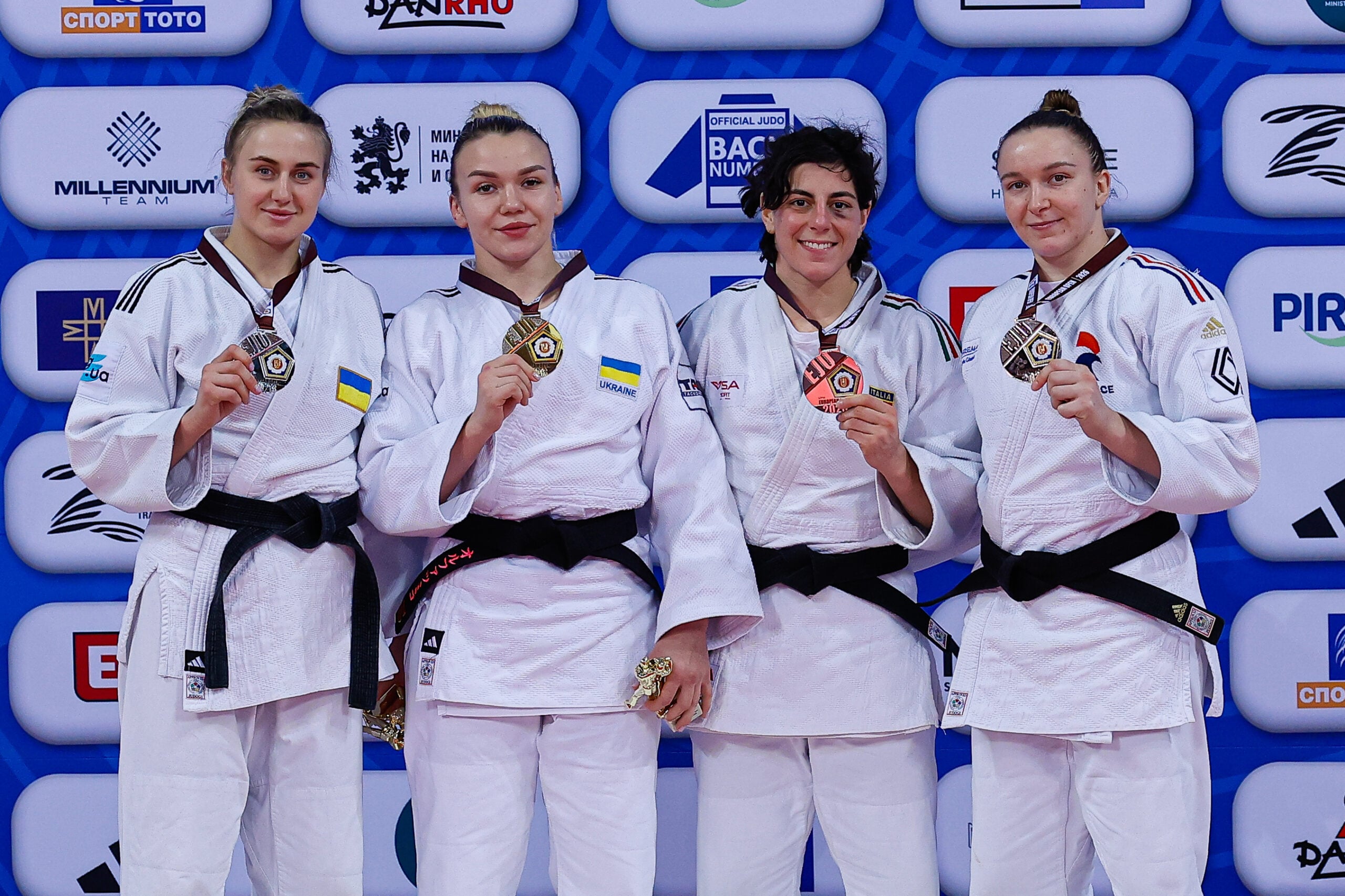
Waiting in the final was Anastasiia Antipina. Not just a fellow Ukrainian. Not just a teammate. Her best friend. The person she trains with daily, who knows her judo intimately, whose strengths and weaknesses are as familiar as her own.
In left-versus-left exchanges, Tsimko struck first, a maki-komi counter for waza-ari. She followed with a left-sided harai-maki-komi for another score, then doubled her advantage with yet another counter. Antipina fought until the final buzzer but the table couldn’t be turned.
When it ended, both athletes embraced, tears, laughter, relief, joy all mingled together. Gold and silver for Ukraine. Victory and defeat for two friends who would travelled this journey together.
“She Always Believes in Me”
Speaking after the medal ceremony, Tsimko’s emotion was still raw, her English halting but her message clear. “I am very, very happy, because this is my first gold medal at a European Open,” she said, the smile never leaving her face. “I feel good, very good. My coach was always with me today, all day and she believes in me and helps me and tells me important things.”
When asked about the final, her expression shifted, happiness mixed with something deeper. “The most difficult moment was the final today because I competed against my best friend. We train together and it was challenging to get into the right mindset.” She paused, choosing her words carefully. “I want to thank her for this fight.”
It is the contradiction at judo’s heart, a sport built on mutual welfare and benefit, where you must defeat the people you care about most to achieve your dreams. Where your training partner becomes your opponent, where friendship doesn’t pause for minutes on the tatami, where embracing after combat carries more weight than the medal itself.
The world ranking will adjust. Seedings will improve. Future opponents will prepare differently but the memory of this weekend, of proving herself round by round, of facing her hardest test in the final, of sharing the podium with her best friend, will remain.
The lasting image from the -70kg final won’t be any particular technique or score. It will be two young women, one draped in gold and one in silver, holding each other on the tatami, competitors for a few minutes, friends for life. That is judo. That is sport. That is friendship tested and strengthened by competition. Olha Tsimko is a European Judo Open gold medallist and she did it the hardest way possible.
Author: Szandra Szogedi