






There is a particular type of athlete who lets their work speak louder than their words. Timur Arbuzov, the newly crowned -81kg world champion and world number one, is precisely that type. His answers are economical, almost austere in their brevity. Yet, within that economy lies something profound, a clarity of purpose so complete that elaboration becomes unnecessary.

“My task is to train; I don’t think about anything else,” he states when asked about the pressure of being world number one. It is a sentence that could be mistaken for simplicity but is actually the distilled essence of a philosophy that has carried him from devastating early defeats to the summit of world judo.
The Crucible of Failure
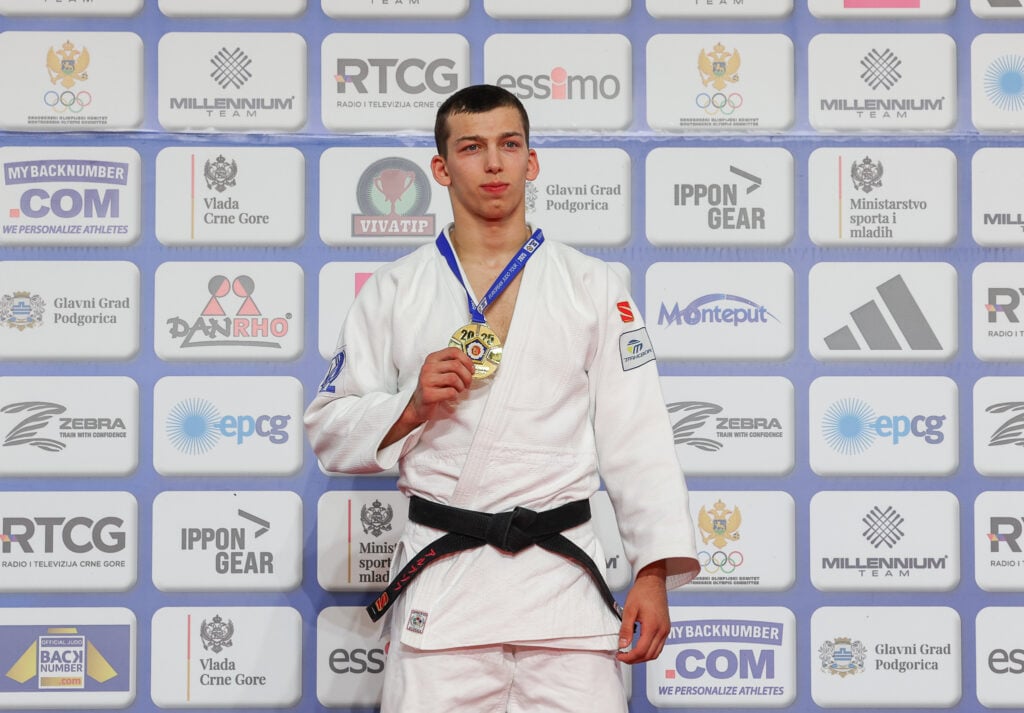
Before Timur Arbuzov stood atop the podium in Budapest, before he claimed the European title in Podgorica and the Grand Slam crown in Tashkent, there was a period that nearly defined his career in an entirely different way. His first four senior-level tournaments ended in defeat, a brutal initiation for an athlete accustomed to success at cadet and junior levels.
“It was a difficult period for me because I had never had so many consecutive defeats,” he admits, revealing one of the rare moments where emotion colours his typically measured tone. “It was precisely after these losses that I drew conclusions and became stronger.”
This transformation, from promising junior to struggling senior competitor and then to world champion, represents one of judo’s most challenging transitions. The shift isn’t merely physical, though the speed, power and tactical sophistication of senior competition certainly demand adaptation. It is psychological. Moving from being the hunter to being hunted, from proving yourself capable to proving yourself worthy of your reputation.
For Arbuzov, those four consecutive defeats served as a mirror, forcing him to confront not just technical deficiencies but deeper questions about preparation, resilience and the mental fortitude required at sport’s highest level. Rather than retreating or making excuses, he leaned into the discomfort.
“After the defeat during Tokyo Grand Slam 2024 to Sotaro Fujiwara, I re-evaluated my approach to fighting left-handed opponents and worked to improve my performance against them,” he explains, demonstrating the analytical rigour he applies to setbacks. Each loss becomes a lesson; each lesson becomes fuel.
The Architecture of Support
If Arbuzov’s success were a building, its foundation would be unmistakable. When asked about the origins of his achievements, he doesn’t speak of individual talent or natural gifts. Instead, he immediately credits the team that has surrounded him since his youth.
“From my youth until today, I have been surrounded by the same people who believe in me. My personal coach, our national team coaches and my father. They are the foundation of my victories,” he states with characteristic directness.
This consistency of support, the same voices, the same belief system, the same commitment extending across years, has created an environment where Arbuzov can focus entirely on improvement without the distraction of constantly recalibrating relationships or philosophies. When asked how his training has evolved as he is matured, his answer is revealing in its simplicity: “I try to listen to my coaches in everything. They adjust and change the training plan.”
It is a statement that speaks to trust earned over time. Arbuzov doesn’t need to micromanage his development because he is invested in a system proven to work. His father’s presence in that foundation adds another dimension, this isn’t merely professional support but familial belief woven into the fabric of his sporting identity.
The team approach extends beyond coaching. When discussing the current Russian generation and the fierce competition within the -81kg division, Arbuzov observes: “We have a very strong -81kg weight class in our country and through this level of competition we become stronger. We spend a lot of time together and grow through each other. There is always something to learn, both from the seniors and from the juniors.”
The Tactical Evolution
Arbuzov’s judo is characterised by what observers describe as a balance between explosive attacks and tactical control, a rare combination that requires both physical prowess and strategic intelligence. When asked about his technical development, he focuses on two key areas: flexibility and groundwork.
“I think it is the development of my flexibility and my groundwork and these are the areas I am trying to keep improving,” he notes, revealing priorities that might surprise those who see only the spectacular throws.
His preparation for major events reflects this holistic approach. “I try to work more on my endurance and on my technique, especially the techniques I use most often,” he explains.
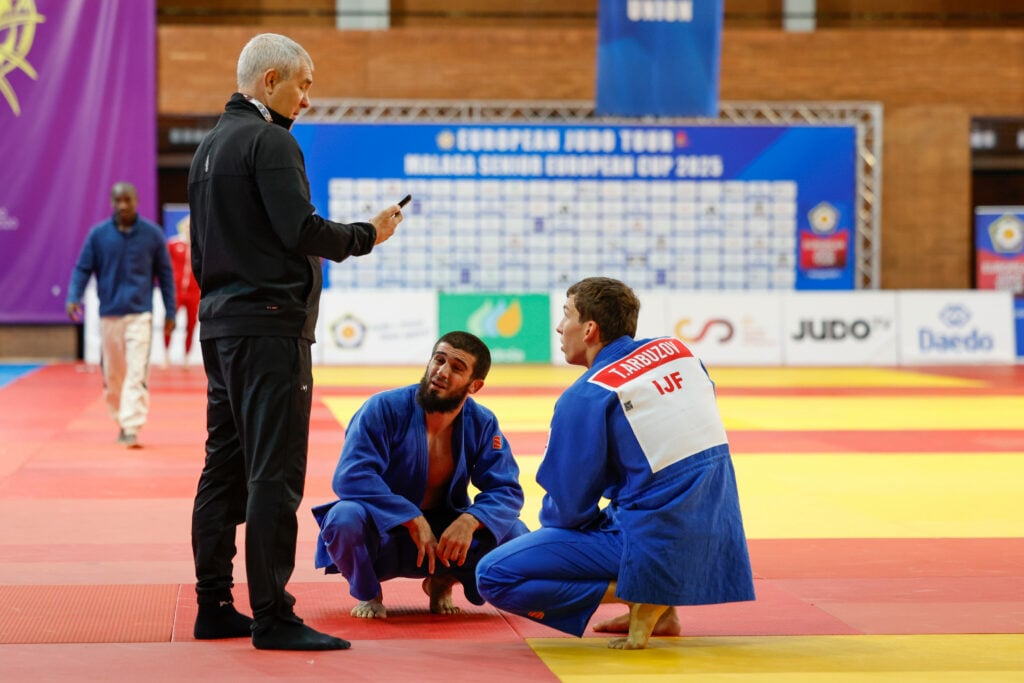
The decision to compete briefly in the -90kg category at the European Cup in Malaga demonstrates another facet of Arbuzov’s development, the willingness to test himself outside his comfort zone. “They are slightly slower than those in -81kg but physically stronger, so it was not easy,” he reflects. The experiment provided valuable data about adjusting to different opponent profiles, knowledge that may prove crucial in his stated ambition to move up a weight category after the 2028 Olympics.
Faith as Foundation
In an era where sports psychology has become increasingly sophisticated, with athletes employing various mental coaches, meditation techniques and visualisation protocols, Arbuzov’s approach stands out for its clarity. When asked about the philosophy that helps him remain consistent under pressure, his answer is immediate and unequivocal: “My religion helps me cope with all the pressure.”
Faith provides not just comfort but structure, a framework for understanding both success and setback, a source of perspective when the weight of expectations becomes heavy. This spiritual dimension also influences how he processes defeat. “I get very upset after defeats and often that motivates me to work even harder,” he admits. The emotion isn’t suppressed or denied; it is acknowledged, felt fully and then channeled into productive action.

The Hunger That Remains
Perhaps the most striking aspect of Arbuzov’s mindset is that, despite achieving what many would consider a career-defining accomplishment in Budapest, he speaks about his future with the urgency of someone who has yet to prove themselves.
“In my country, there has never been a four-time world champion or a two-time Olympic champion. I want to set some kind of record, that is what motivates me,” he reveals, offering a glimpse into the ambitions that drive him beyond the immediate satisfaction of victory. This record-breaking mentality transforms his World Championship from an endpoint into a waypoint.
When asked about his targets for the coming season, his answer is audacious in its simplicity: “I want to win every bout without losing a single one.” It is the kind of goal that might seem unrealistic, in a sport as unpredictable as judo, perfection is virtually impossible but it reveals the standard against which he measures himself. Anything less than victory isn’t failure but it’s not the target either.
The International Chessboard
Arbuzov’s tactical intelligence extends to his understanding of different national styles. When asked about opponents who push him most, he identifies Georgia and Japan as the world’s leading judo nations, a recognition grounded in experience rather than stereotype.
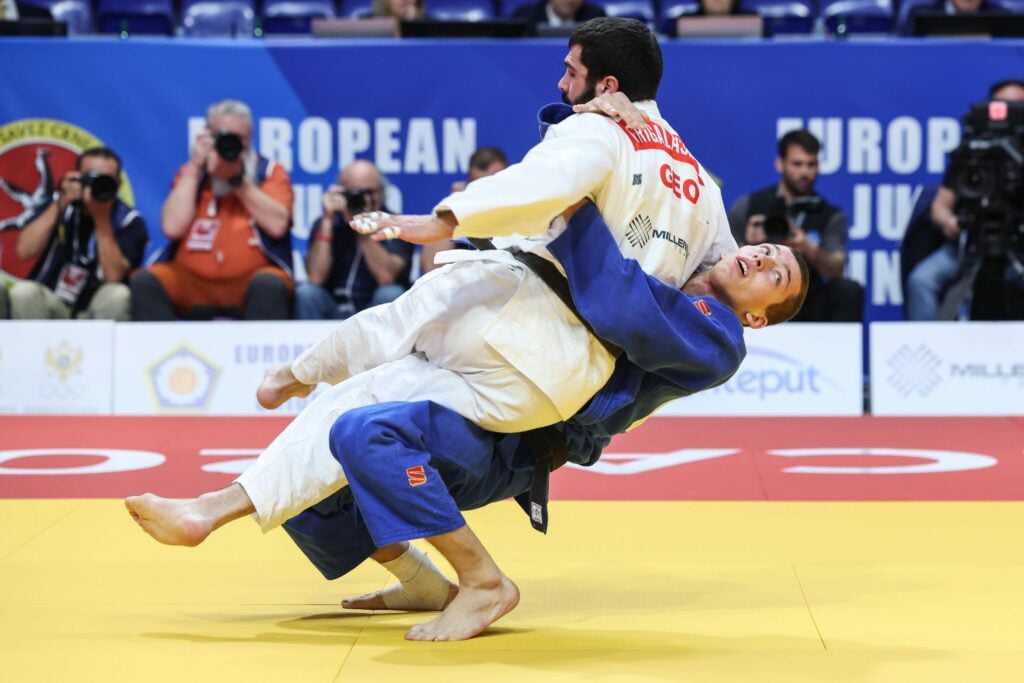
“I try to impose my own style on all my opponents,” he states when discussing how he adapts to different approaches. The 2025 World Championship final against Tato Grigalashvili of Georgia encapsulated this approach. “I tried to step onto the mat with confidence and a cool head. The final turned out to be very interesting. Tato is a very strong athlete,” Arbuzov recalls. The respect for his opponent’s abilities doesn’t translate into hesitation or overcomplication, just focused execution of his game plan against a world-class competitor.
Legacy in Motion
As Arbuzov looks towards the remainder of his career with ambitions, his message to young judoka carries the weight of lived experience: “Train hard and believe in yourselves and everything will definitely work out.”
At 21, with a World Championship gold medal and a world number one ranking already secured, Arbuzov stands at a fascinating juncture. He has achieved what many never will, yet speaks about his future with the hunger of someone still proving themselves. The four-time World Championship and two-time Olympic Championship records he aspires to break remain distant, requiring years more of the same disciplined focus that brought him to this point.
Yet, if his 2025 season demonstrated anything, it is that Arbuzov possesses something perhaps rarer than talent: the ability to sustain excellence without being consumed by it. His task remains what it has always been, to train. Everything else, he trusts, will follow. The quiet fire burns on and in the -81kg division, everyone else had better prepare for the heat.
Author: Szandra Szogedi