





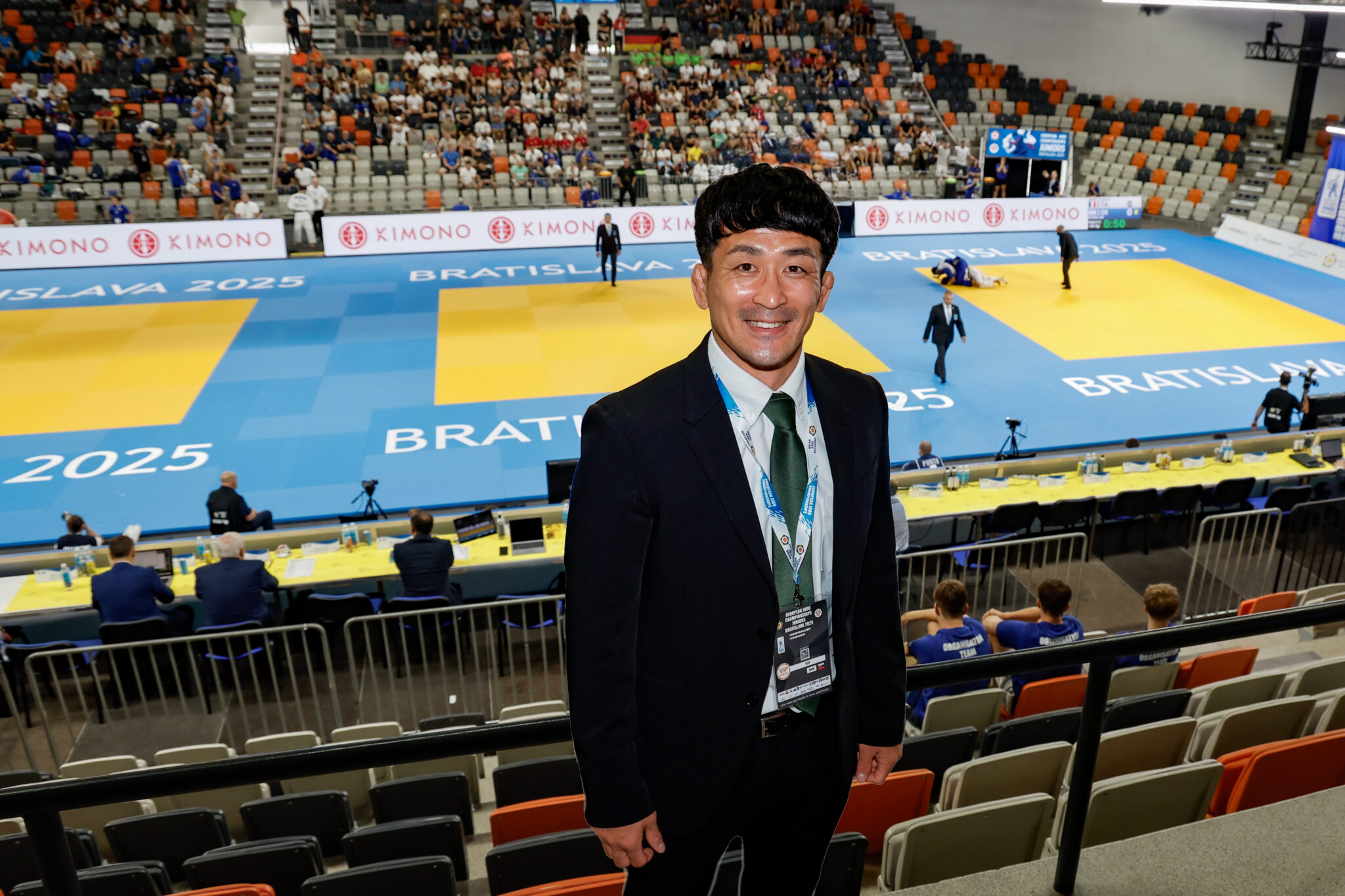
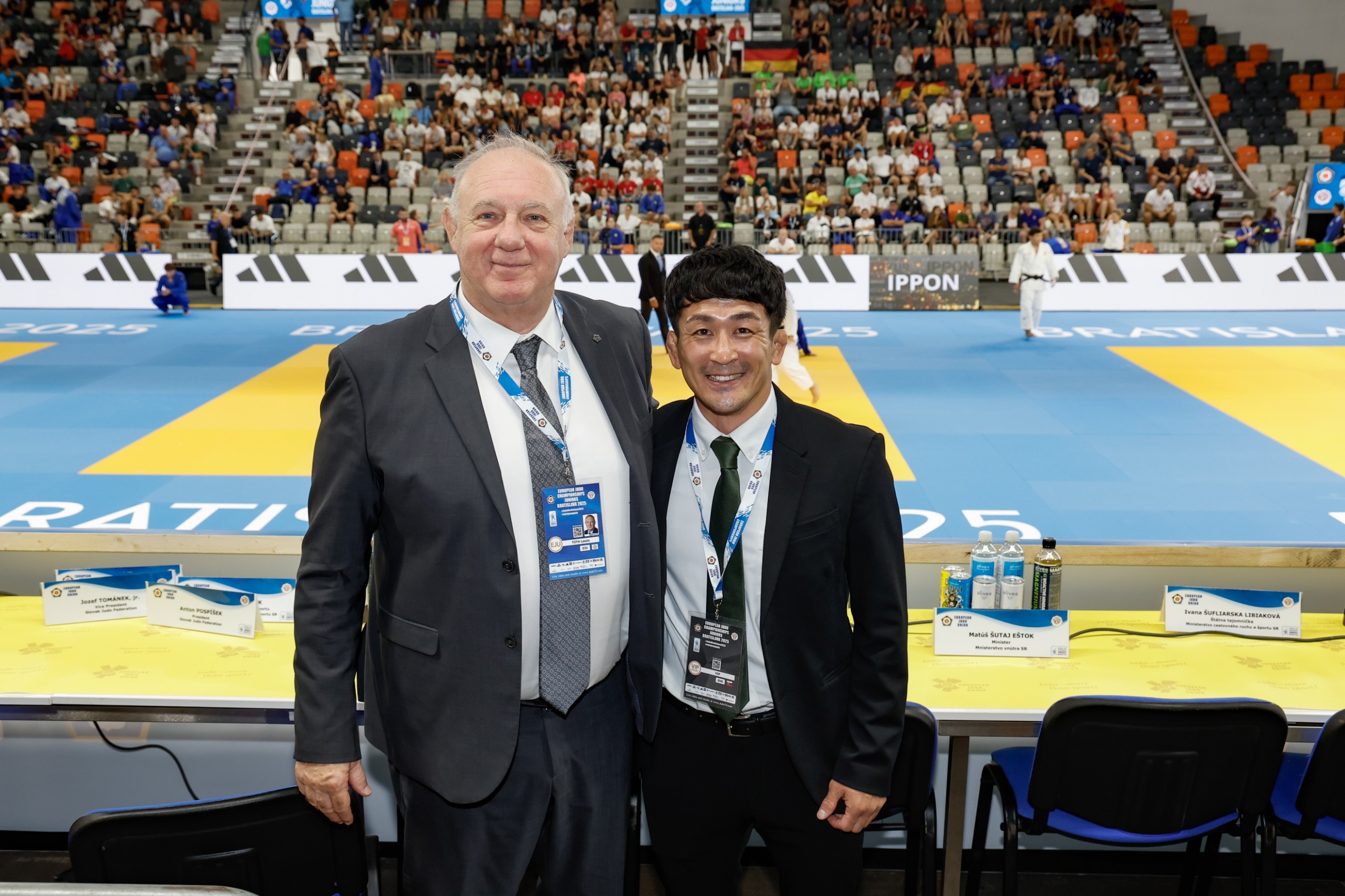
At the Junior European Judo Championships 2025 in Bratislava, the stands are filled with familiar faces, former champions, coaches, and leaders of the sport. Among them, one presence stands out: Hiroyuki Akimoto, the 2010 World Champion and CEO of Kimono Fighter, a company proudly supporting this year’s event.

We caught up with Akimoto to learn more about his journey from world-class judoka to entrepreneur, and why he has chosen to invest in the future of judo, particularly in Europe.
Q1. Could you tell us the story of your company, how it started and what values guide it today?
A1. After finishing my judo career, I wanted to contribute to the world through judo. Not only through coaching, but also by finding another way to support the judo community. Using my own experience and knowledge, I came up with the idea of developing and producing judogi and jiu-jitsu gi. That led me to establish Kimono Fighter.
Q2. What inspired you to support the Junior European Judo Championships in particular?
A2. In Slovakia, I have a respected junior colleague, Ryugo Ide, who invited me to get involved in judo coaching. Through him, I was introduced to his employer, Professor Jozef Tomanek, and since the Junior European Championships were approaching, this naturally led to our decision to support the event.
Q3. Do you have any connections to Slovakia outside of supporting the event?
A3. My strongest connection is through my junior colleague, Ryugo Ide. In addition, the Slovak team visited Tsukuba University, where we had the chance to strengthen international exchange and build friendships. That experience also played an important role.
Q4. Why do you feel it is important to invest in junior-level athletes rather than only at senior or elite competitions?
A4. The future of judo will be built by the younger generation. That is why I believe it is essential to support them and to pass on the judo spirit and mindset from senior athletes to juniors for the future of our sport.
Q5. How do you see the future of your company in the global judo community?
A5. At the moment, our company is still small and we have not yet obtained the official IJF mark. Our first goal is to achieve this in the near future, and to deliver Kimono Fighter judogi to as many people as possible. In particular, since young athletes train very hard, we aim to develop and provide durable and affordable judogi for them.
Q6. Are there plans for further collaborations or sponsorships in Europe or elsewhere?
A6. We are currently developing a collaboration judogi with Olympic gold medallist Keiji Suzuki. In the future, we are planning more collaborations with other medallists as well. If the opportunity arises, we would like to continue sponsoring and exhibiting at European tournaments, to further increase the recognition of Kimono Fighter in Europe.
Q7. What do you think about the organisation and the level of judo at this event?
A7. Compared to Japan, I felt that many athletes here fight more in close contact and that their physical abilities are very strong. There are many aspects that Japanese athletes can learn from them. The organisation of the tournament was smooth and efficient, and I believe the athletes were able to compete without stress.
Author: Szandra Szogedi